“First principles” is the practice of breaking a complex problem down to its most fundamental truths, solving for those, and building back up until you’ve conquered the bigger objective. Elon Musk made the term popular because it’s how he pushes his teams to innovate. It also happens to be a useful way to think about one of healthcare’s most overused phrases: patient access.
Patient access is one of those words that means different things to different people. Strip it down, though, and it’s about one thing: the set of processes that determine whether and how a patient receives care.
So what’s the most fundamental truth underneath it? It’s how a patient makes an appointment with their provider. Not just the mechanics of booking, but how in tune the clinic is with what its patients actually need, and what it does to reach out proactively based on those needs.
In other words, patient access starts with knowing your patients and regularly checking in to see how they’re doing.
Simple in theory. Much harder in practice. No ambulatory clinic can afford to staff a team dedicated to proactively call thousands of patients, one by one.
This is where conversational AI fits.
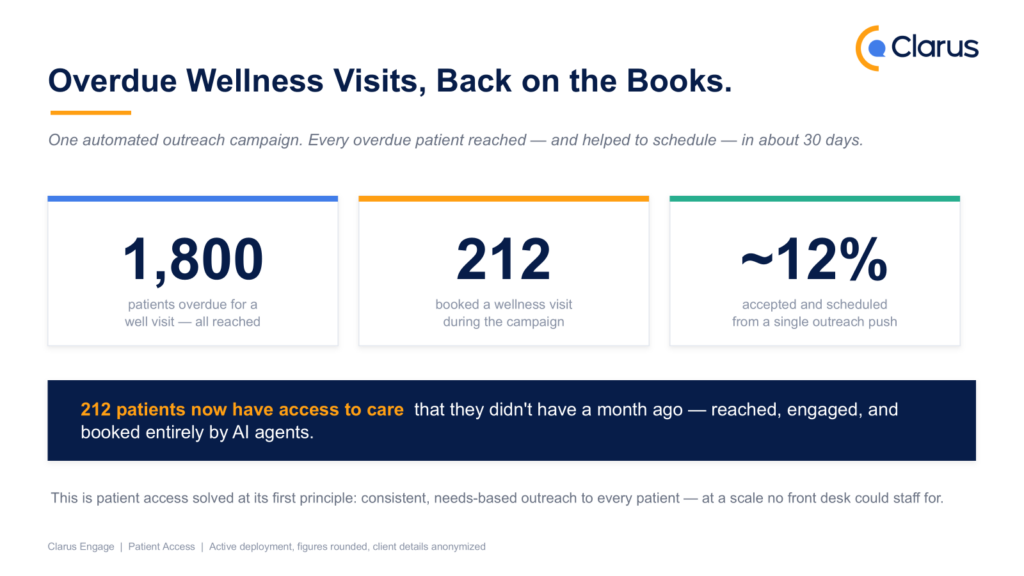
Here’s a real world example of how conversational AI made a vast improvement in patient access for one of Clarus’ customers. A primary care practice had roughly 1,800 patients overdue for a wellness visit ranging from six months to two years since they were last seen. Our conversational AI platform, Engage, manages AI agents that call and text those patients to check in and help them schedule. Over a 30-day period, 212 of them booked a visit — nearly 12%. That’s 212 patients with access they didn’t have a month earlier.
There are hundreds of campaigns like this in production across clinics and home health agencies nationwide — procedure follow-up, in-home nurse visits, medication adherence, and a range of chronic care gaps.
None of it is complicated. It’s solving the first principle of access through consistent, needs-based communication: asking patients how they’re doing and whether they need help. That’s how conversational AI is making a difference today.
As one VP of Ambulatory Operations at a 72-clinic health system recently put it: “This way of communicating with patients will be how it’s done in the future. So to the extent we can get going now, why wouldn’t we?”