“First principles” is the practice of breaking a complex problem down to its most fundamental truths, solving for those, and building back up until you’ve conquered the bigger objective. Elon Musk made the term popular because it’s how he pushes his teams to innovate. It also happens to be a useful way to think about one of healthcare’s most overused phrases: patient access.
Patient access is one of those words that means different things to different people. Strip it down, though, and it’s about one thing: the set of processes that determine whether and how a patient receives care.
So what’s the most fundamental truth underneath it? It’s how a patient makes an appointment with their provider. Not just the mechanics of booking, but how in tune the clinic is with what its patients actually need, and what it does to reach out proactively based on those needs.
In other words, patient access starts with knowing your patients and regularly checking in to see how they’re doing.
Simple in theory. Much harder in practice. No ambulatory clinic can afford to staff a team dedicated to proactively call thousands of patients, one by one.
This is where conversational AI fits.
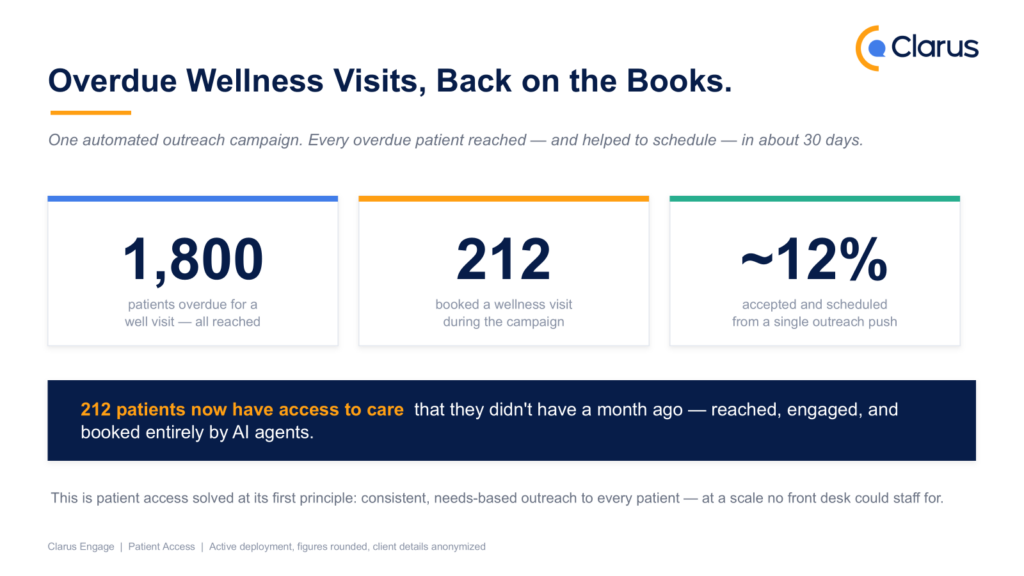
Here’s a real world example of how conversational AI made a vast improvement in patient access for one of Clarus’ customers. A primary care practice had roughly 1,800 patients overdue for a wellness visit ranging from six months to two years since they were last seen. Our conversational AI platform, Engage, manages AI agents that call and text those patients to check in and help them schedule. Over a 30-day period, 212 of them booked a visit — nearly 12%. That’s 212 patients with access they didn’t have a month earlier.
There are hundreds of campaigns like this in production across clinics and home health agencies nationwide — procedure follow-up, in-home nurse visits, medication adherence, and a range of chronic care gaps.
None of it is complicated. It’s solving the first principle of access through consistent, needs-based communication: asking patients how they’re doing and whether they need help. That’s how conversational AI is making a difference today.
As one VP of Ambulatory Operations at a 72-clinic health system recently put it: “This way of communicating with patients will be how it’s done in the future. So to the extent we can get going now, why wouldn’t we?”
Acquisition positions Clarus among the leaders in conversational AI across the ambulatory, home health, and MSO segments
NASHVILLE, Tenn. — June 18, 2026 — Clarus, a call management and patient engagement platform for growing healthcare organizations and a subsidiary of Graham Holdings (NYSE: GHC), today announced the acquisition of Flowline Health, a leading provider of conversational AI and patient engagement.
Combined with Clarus’ 10+ years of experience and over 60 million patient interactions, Flowline’s expertise uniquely positions Clarus to help healthcare organizations deliver a higher level of care, make staff and providers more productive, and capture revenue they’re losing today.
Clarus is proud to offer a suite of leading products in this space, backed by a decade of knowing what actually happens when patients call. Clarus handles more than 14 million patient calls a year for medical practices and health systems nationwide, and the addition of Flowline extends that platform with conversational AI across both voice and text.
Most healthcare organizations are adopting conversational AI for the first time, and what sets the combined company apart is the ability to make it produce real results. Flowline’s technology, paired with Clarus’ scale and experience, gives healthcare organizations a path to deploy conversational AI and see real outcomes quickly, not just run another pilot.
The combined platform meets patients on the channels they use, by phone and by text, and works across both inbound and outbound. Clarus answers the inbound calls and messages that keep a practice running, while Flowline strengthens engagement on both sides, reaching patients proactively to confirm appointments, close care gaps, and follow up on the outreach that too often falls to overextended staff. The result is one platform built for the full range of patient communication, rather than a patchwork of point solutions.
The acquisition reinforces Clarus’ commitment to the ambulatory, home health, and MSO segments, where conversational AI can help close persistent gaps in patient communication: missed follow-ups, unanswered calls, and manual outreach that pulls staff away from patient care.
“Gabe and I started Flowline because we believed conversational AI would become foundational to the future of healthcare operations,” said Andrew Bull, co-founder of Flowline Health. “Deploying our solutions in the real world has been tremendously rewarding. Joining Clarus, a leading platform already handling millions of patient interactions a year, lets us put our technology to work for practices at a real scale, and do what we always dreamed of: help patients and providers every day.”
“Clarus and Flowline have always been chasing the same thing: ensuring patients have world-class access to care, and providers can run sustainable businesses,” said Gabe Mamallo, co-founder of Flowline Health. “Coming together lets us serve patients and providers, across voice and text, in a way neither of us could alone. I’m excited about what we’re going to build for the practices and patients who count on us.”
Clarus and Flowline will share more about the combined product roadmap in the coming months.
About Clarus
Clarus is a call management and patient engagement platform for growing healthcare organizations, handling more than 14 million patient calls a year for practices and health systems nationwide, built on 10+ years of experience and over 60 million patient interactions. Clarus is a subsidiary of Graham Holdings (NYSE: GHC). Learn more at claruscare.com.
###
The Problem: Managing Urgent Home Infusion Therapy Calls Created Operational Challenges
PromptCare, a home infusion provider specializing in IVIG therapies and biologics needed a reliable way to manage urgent after-hours patient calls. For patients experiencing critical events, rapid response times are essential. However, the organization’s previous on-call process required multiple layers of communication and placed a significant burden on clinical staff.
Key challenges included:
- Complex after-hours call management workflows
- Too many team members involved in the on-call process
- Difficulty efficiently routing urgent patient calls to the appropriate clinician
- Increased risk of staff burnout due to constant on-call responsibilities
- Limited work-life balance for nurses and pharmacists managing after-hours communications
As a result, PromptCare needed a more efficient and streamlined solution to manage urgent patient communications while reducing operational burden.
The Solution: A Centralized, Easy-to-Use Call Management App
PromptCare implemented Clarus to simplify after-hours communication and ensure urgent patient needs were routed quickly to the appropriate clinician.
Key capabilities included:
- Automated routing of after-hours patient calls
- Direct communication between triage nurses, pharmacists, and field nurses
- Multiple notification options including phone calls and text alerts
- Easy-to-use mobile application requiring minimal training
- Centralized management of all after-hours communications
With Clarus in place, urgent patient calls are quickly routed to the appropriate care team member, helping nurses respond rapidly to time-sensitive situations while improving operational efficiency.
The Problem: Slow Patient Response Times Led to Patient Dissatisfaction and Staff Burnout
Before implementing Clarus, CoreLife did not have a formal call management system in place. Incoming patient calls were routed directly to voicemail whenever front desk staff were busy with in-clinic patients.
This created several operational challenges:
- No structured process for managing or following up on patient calls
- Front desk staff overwhelmed by a constant stream of incoming calls
- Limited time for staff to complete other essential daily responsibilities
- Reduced ability to deliver a coordinated, high-quality patient experience
As a result, staff were stretched thin, and clinic efficiency and patient communication suffered.
The Solution: Structured Call Management and Triage with Clarus
CoreLife replaced their voicemail-based system with a structured, centralized call management solution that automatically categorized and routed patient messages to the appropriate team members.
Key capabilities included:
- Automated call triage and message routing
- Centralized Clarus dashboard for full visibility into patient communications
- User-friendly interface for staff, managers, and leadership
- Minimal learning curve and rapid team-wide adoption
- Improved prioritization of patient needs and internal workflows
With the usage of Clarus, CoreLife’s front desk team was able to step away from constant phone interruptions and refocus on higher-value responsibilities.
The Problem: Slow Patient Response Times Led to Patient Dissatisfaction and Staff Burnout
Sauk Prairie Healthcare’s leadership recognized significant challenges with their existing medical answering and call management process.
- Patients often waited 2–3 business days for a response
- Delayed communication led to increased patient complaints
- Some patients chose to leave the practice due to dissatisfaction
- Staff were overwhelmed managing more than 6,000 calls per month
- High call volume contributed to staff fatigue and burnout
As a result, the organization needed a more efficient, scalable solution to improve patient communication and reduce strain on staff.
The Solution: Faster, More Efficient Daytime Patient Communication with Clarus
Sauk Prairie Healthcare implemented Clarus to modernize patient communication and streamline high-volume call management.
Key capabilities included:
- Faster response times, enabling callbacks within hours instead of days
- Automated call sorting to prioritize and route patient requests efficiently
- Reduced staffing costs compared to hiring additional full-time employees
- Improved patient satisfaction through quicker communication
- Reduced staff burnout by decreasing operational workload
With Clarus in place, Sauk Prairie Healthcare significantly improved patient response times, enhanced patient satisfaction, and reduced staff overload through a more efficient communication system.
The Problem: Inaccurate Messaging and High Costs from Traditional Medical Answering Services
Sylacauga Obstetrics & Gynecology relied on a traditional medical answering service that created both financial and clinical communication challenges.
- High monthly costs for call center operators
- Inconsistent and unreliable message documentation
- Lack of direct communication with patients increased uncertainty
- Risk to patient care due to misinterpreted or missing details
As a result, the OBGYN practice needed a more reliable, cost-effective, and secure patient communication solution.
The Solution: A Simple, Scalable HIPAA-Compliant Patient Communication System
In 2015, Sylacauga Obstetrics & Gynecology implemented Clarus to modernize its patient communication and reduce reliance on traditional answering services.
Key capabilities included:
- Lower monthly costs compared to traditional call centers
- Improved HIPAA-compliant communication and data protection
- AI-powered transcription for accurate message capture
- Ability for providers and staff to read or listen to messages through a centralized dashboard
- More direct, reliable patient communication workflows
With Clarus in place, the OBGYN practice improved message accuracy, enhanced compliance, and reduced operational costs while delivering more reliable patient communication.
The Problem: Limited Call Visibility and Labor-Intensive Documentation
MidState Pulmonary faced operational challenges with its traditional call management and documentation processes.
- Limited visibility into patient call activity and communication
- Manual, time-consuming documentation of patient interactions
- Inefficient workflows for tracking and routing messages
- High staffing costs to manage call volume and documentation tasks
- Difficulty integrating call information into patient medical records
As a result, the pulmonary practice needed a more efficient and scalable solution to improve visibility, reduce administrative burden, and lower operational costs.
The Solution: A Cost-Effective, Technology-Based Call Management System
MidState Pulmonary implemented Clarus to streamline call handling, improve documentation accuracy, and reduce staffing demands.
Key capabilities included:
- Automated, timestamped call documentation
- Real-time visibility into patient call activity
- Faster call routing and urgent prioritization
- Reduced staffing needs
- Lower monthly expenses compared to traditional medical call centers
With Clarus in place, the practice improved efficiency, enhanced documentation accuracy, and significantly reduced operational costs while maintaining high-quality patient communication.
The Problem: Traditional Medical Answering Service Caused Inaccurate Documentation
Chicago Nasal and Sinus Center relied on a traditional answering service to manage after-hours patient calls, which led to ongoing communication challenges.
- Patient messages were documented incorrectly or with missing information
- Incorrect phone numbers and details led to miscommunication and delays
- Physicians occasionally received calls with wrong patient context or names
- Dialing errors and inaccurate message capture impacted workflow efficiency
- These issues impacted patient care and reflected poorly on the practice
As a result, the practice recognized the need for a more accurate and reliable call management solution.
The Solution: AI-Transcription and Documentation Through Clarus Call Management
Chicago Nasal and Sinus Center implemented Clarus to modernize its after-hours call handling and improve communication accuracy.
Key capabilities included:
- Automated routing to the appropriate on-call provider
- Mobile app access for easy on-call schedule management
- Accurate AI transcription of patient messages
- Ability to read or listen to patient messages on demand
- Improved organization and documentation of all patient communications
With Clarus in place, the practice reduced communication errors, improved staff efficiency, and ensured more accurate and reliable patient interactions.
The Problem: Traditional Medical Answering Service Caused Delays in Patient Communication
Women’s Care of Beverly Hills faced ongoing challenges with its traditional medical answering service, particularly in delayed response times and time-consuming workflows.
- Delayed response times to patient inquiries
- Inefficient handling of voice messages during and after office hours
- Poor visibility into patient communication
- Missed opportunities for timely follow-up and care coordination
- Communication breakdowns that impacted both patients and providers
As a result, the practice needed a more efficient and reliable way to manage patient calls and messages.
The Solution: An Easy-to-Use Technology-Based Call Management Solution
Women’s Care of Beverly Hills implemented Clarus’s innovative call management system to modernize its patient communication and call management process.
Key capabilities included:
- Centralized visibility into all patient calls and messages through a centralized dashboard
- Ability to categorize messages by type and prioritize urgent needs
- Mobile app access for providers and staff to manage communications easily
- Improved documentation and tracking for better operational oversight
- Lower monthly costs compared to traditional call center services
With Clarus in place, the women’s health practice significantly improved communication efficiency, reduced administrative burden, and enhanced the overall patient and provider experience.
The Problem: High-Cost Medical Call Center Couldn’t Scale with Practice Growth
Kansas City Bone & Joint, a growing orthopedic practice with 20+ providers, relied on a traditional live operator system to manage daytime and after-hours patient calls. As call volume increased, the system became costly and less efficient for the practice’s needs.
- High monthly expense for live medical call operator services
- Limited scalability as the practice continued to grow
- Inefficient call handling for a multi-provider organization
- Need for a more modern and flexible call management solution
As a result, they began searching for a more cost-effective and scalable approach to patient call management.
The Solution: A More Affordable, Scalable Patient Communication Solution
Kansas City Bone & Joint implemented Clarus’s AI-powered call management solution to replace its medical answering service with a scalable, technology-based platform designed for growing healthcare practices.
Key capabilities included:
- Cost savings compared to a traditional medical answering service
- Streamlined, more efficient patient call experience
- 24/7 support for patient communication
- Easy-to-use mobile dashboard to manage incoming calls and provider on-call schedules
- Fast implementation with immediate operational impact
According to Executive Director Caressa Lynch, Clarus’s call management solution immediately improved the call experience for both patients and providers, while positioning the practice for continued growth.